Understanding the Risk: Dust Explosion Fundamentals
Dust explosions represent one of the most serious safety hazards in industrial operations, particularly within facilities handling combustible materials. From power generation plants and steel mills to cement manufacturers and chemical processing facilities, the risk profile remains consistently high across industries. An industrial dust explosion occurs when airborne dust particles, suspended within a confined space at sufficient concentration, ignite in the presence of an ignition source. The resulting rapid exothermic reaction generates extreme pressure and heat—often exceeding 1,000 degrees Fahrenheit—causing catastrophic damage to equipment, infrastructure, and personnel.
The explosion pentagon model illustrates five critical conditions necessary for a dust explosion: combustible dust, appropriate particle size, sufficient concentration (within the explosive range), oxygen, and an ignition source. Unlike gas explosions, dust explosions operate through a complex chain reaction. When initial dust particles ignite, the resulting heat suspends additional particles into the air, creating a secondary and often more destructive explosion. Industry data demonstrates that secondary explosions frequently cause greater damage than primary events—a critical distinction that shapes how modern dust collection strategies must be engineered.
The Role of Dust Collectors and Baghouse Filter Bags
Contact OmelaA properly functioning dust collector serves as the primary line of defense against dust accumulation and airborne particle migration. However, the dust collector itself can become a critical explosion hazard if not properly designed, maintained, and equipped. This paradox requires facility managers to view dust collection not merely as an air quality compliance measure, but as a fundamental safety infrastructure component.
The heart of any dust collector system lies in its filtration media—specifically, baghouse filter bags. These engineered textiles are responsible for capturing particles at the point of generation while maintaining operational efficiency under demanding conditions. The selection of appropriate filter bag material, specifically considering factors like filtration efficiency, heat resistance, and chemical compatibility, directly impacts both safety and performance.
Omela Filtration specializes in engineered filter bag solutions designed with safety-first engineering principles. Our baghouse filter bags are manufactured from premium materials including PTFE (polytetrafluoroethylene), PPS (polyphenylene sulfide), and aramid filter bag materials—each selected for specific industrial applications and hazard profiles.
Material Science and Explosion Prevention
Max Temperature (°C)
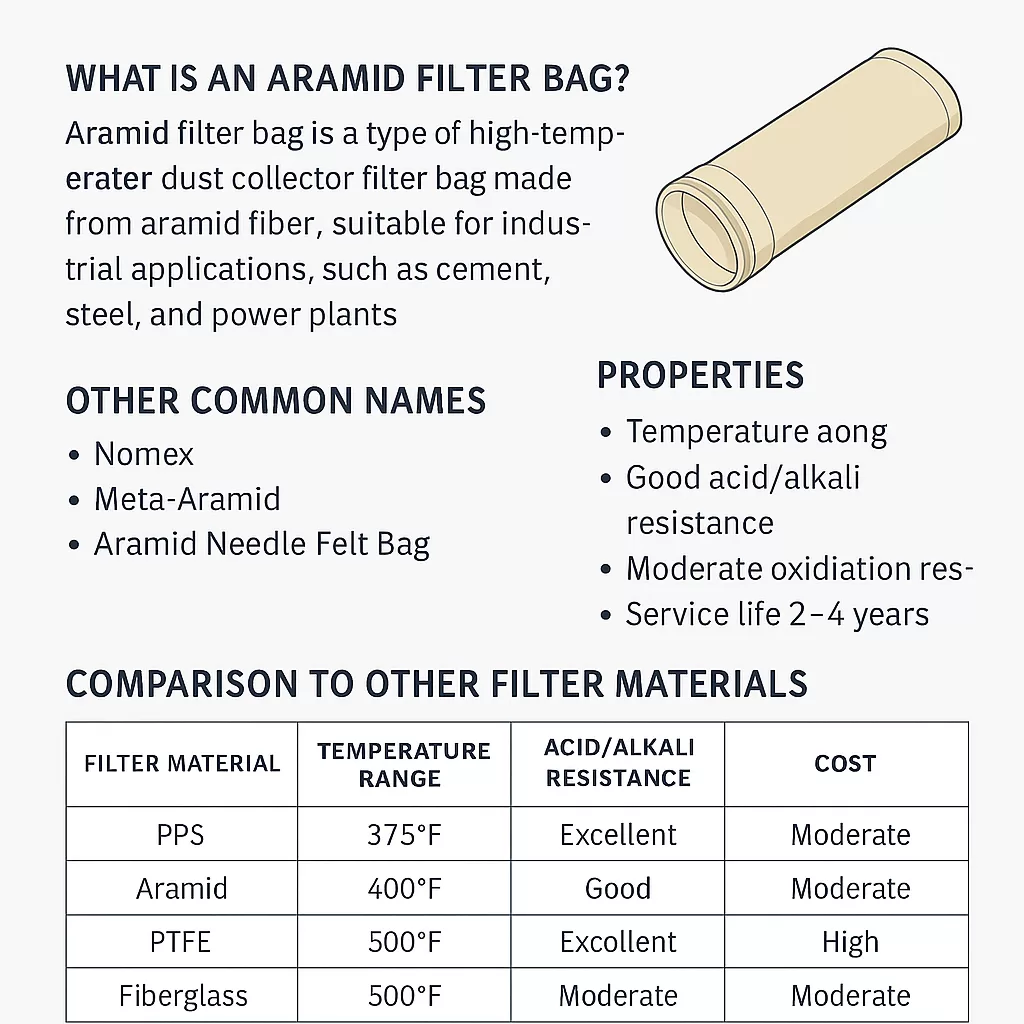
The choice of filter bag material represents a critical safety decision. PTFE filter bags offer exceptional chemical resistance and thermal stability, making them ideal for aggressive chemical processing environments where explosive dust particles might possess reactive properties. PPS filter bags excel in high-temperature applications, maintaining structural integrity at temperatures where conventional materials would fail. Aramid filter bag materials provide superior mechanical strength and static dissipation properties—particularly important in facilities handling organic dust streams with inherent electrostatic hazards.
A dust collector equipped with poor-quality or improperly selected filtration media creates multiple explosion risks. Tears or pin-holes in filter bags allow uncontrolled particle migration, bypassing the system’s protective function. Inadequate filtration efficiency means higher concentration of airborne dust downstream, increasing ignition probability. Chemical incompatibility between the filter material and process dust can lead to accelerated material degradation, creating safety risks during peak production periods.
Omela’s engineering approach evaluates each facility’s specific dust composition, temperature profile, moisture conditions, and particulate size distribution. This comprehensive analysis informs material selection to ensure optimal filtration efficiency while maintaining structural integrity under operational stress.
System Design and Operational Safeguards
Beyond filter bag selection, comprehensive explosion prevention requires integrated system design. Modern dust collection systems incorporate multiple protective layers:
Proper inlet design minimizes turbulence and particle re-entrainment
Adequate dust hopper capacity and discharge mechanisms prevent overloading
Robust pulse-jet or reverse-air cleaning cycles maintain optimal filter performance
Static dissipation features prevent electrostatic charge accumulation
Blast containment and deflagration relief systems limit pressure buildup
Omela Filtration’s dust collector solutions integrate these design principles from the initial engineering phase. Our baghouse filter bags are engineered with electrical conductivity properties that safely dissipate static charges, eliminating a significant ignition source category. The bags’ consistent porosity ensures predictable pressure drop characteristics, allowing facility managers to optimize cleaning cycles and maintain equipment reliability.
Industry Applications and Real-World Scenarios
Power Generation Facilities:
Coal-fired and biomass power plants generate massive quantities of combustible dust during fuel handling, pulverization, and ash management. Baghouse dust collectors equipped with high-efficiency PTFE and PPS filter bags provide reliable collection while preventing downstream dust migration into operational areas. Proper dust collector maintenance directly correlates with plant safety ratings and insurance premiums.
Steel and Metal Processing Mills:
Iron oxide and metal dust streams present unique explosion hazards due to their pyrophoric characteristics and thermal reactivity. These facilities benefit from robust PPS baghouse filter bags capable of withstanding temperature fluctuations and maintaining consistent filtration efficiency. Effective dust collection prevents accumulation on structural surfaces where secondary explosions initiate.
Cement Manufacturing:
Cement dust production is inherent to grinding and classification operations. Cement dust presents significant respiratory hazards and explosion risks, particularly in confined mill areas. Multi-stage filtration using premium aramid filter bags removes particles at the source while preventing facility-wide dust migration.
Chemical Processing Facilities:
Organic chemical manufacturing generates diverse dust streams—many possessing reactive or hazardous properties. Omela’s PTFE filter bag solutions provide superior chemical resistance, preventing reactions between filter material and process dust that could accelerate degradation or create safety concerns.
Practical Prevention Measures
Installing high-efficiency baghouse filter bags represents only the foundational layer of dust explosion prevention. Comprehensive facility safety requires:
How Omela Filtration Supports Facility Safety
Omela’s approach to dust explosion prevention extends beyond supplying filter products. Our team provides comprehensive consultation addressing:
Our baghouse filter bags undergo rigorous quality testing ensuring consistent performance and reliability. Each product batch receives verification for filtration efficiency, pressure drop characteristics, and material integrity—providing facility managers with confidence in their dust collection system’s protective function.
Conclusion: Preventing Dust Explosions Through Engineering Excellence
Dust explosion prevention requires commitment to multiple protective layers, beginning with high-quality filtration infrastructure. Premium baghouse filter bags manufactured from PTFE, PPS, and aramid materials form the technical foundation of effective dust collection systems.
If your facility handles combustible dust in any form—whether power generation, steel production, cement manufacturing, chemical processing, or related operations—conducting a comprehensive dust explosion risk assessment should be an immediate priority.
Omela Filtration stands ready to support your facility’s safety objectives. Our engineering expertise, combined with premium filter product solutions, helps facilities eliminate dust explosion risks while optimizing operational efficiency and regulatory compliance.
Contact Omela Filtration today to discuss your dust collection requirements. Visit our website at https://www.omelafilter.com to learn more about our complete range of baghouse filter bags and dust collector solutions. Our team of industrial specialists is prepared to evaluate your specific application and recommend optimal filtration strategies aligned with your facility’s unique operational profile and safety requirements.
Understanding the Risk: Dust Explosion Fundamentals Dust explosions represent one of the most serious safety hazards in industrial
Introduction Efficient particulate collection is central to modern industrial air pollution control, making the baghouse a familia
By Omela Filtration — Industrial Filtration Experts 1. Industry Background and the Real Problem In pulse-jet dust collector syst